
Chapter II · The Nupe
A kingdom of craft.
Brass casters, glass makers, weavers and dyers, organised into hereditary guilds, and one of those guilds kept its formula secret for two hundred years.
- c. 1496
- Tsoede born, by tradition
- 18
- Glassmakers who came, by tradition
- 1911
- Beadmaking first documented
- 1942
- Nadel publishes
Movement 02 · The people
A ring, a charm, and a kingdom.
The Nupe trace themselves to one man who arrived as a hostage and left as a king. Historians argue about how much of it is true. The argument is part of the story.
The founding account runs like this. An Igala prince, living in Nupe country, married the daughter of the chief of Nku. Before the child was born, the prince was recalled to Idah to become Attah of the Igala. He left two things behind for the unborn child: a charm, and a distinctive ring.
Years later, that child, Tsoede, also called Edegi, was sent to Idah as part of a slave tribute owed by the royal house of Nku. The Attah saw the ring, recognised his son, and favoured him above his other children. Tsoede eventually returned north, took control of Nupeland, united the clans, and made himself the first etsu Nupe. Tradition dates the founding to 1531 and his death, on a military expedition, to 1591.
He is also credited with bringing brass casting to the Nupe. Given what the following four centuries produced, that is not a small claim.
How the standard ethnography puts it
The culture hero and mythical founder of the Nupe kingdom.
S. F. Nadel, A Black Byzantium, 1942. A phrase doing careful work in both directions
Nadel's wording is deliberate. He separated what he called objective history from ideological history, and he put Tsoede firmly in the second category: a founding account that carries some factual freight while functioning primarily as a claim about legitimacy. Later historians have been blunter still: a 1980s paper in History in Africa reopened the question under the title "The Tsoede Myth and the Nupe Kinglists: More Political Propaganda?"
We are not going to resolve that here, and we are not going to flatten it either. A founding story that binds an Igala father to a Nupe mother, and explains a kingdom's origin as a returning hostage, is doing real political work; it links the Nupe to a powerful neighbour while insisting on their independence from it. That is worth more as a live question than as a tidy legend.
Islam arrived gradually. Etsu Jibiri, reigning around 1770, is recorded as the first Nupe king to become Muslim; the Fulani preacher Mallam Dendo was central to its spread, and his descendants ended up ruling at Bida. Older practice did not simply stop. Shrine ritual and ancestral observance continued alongside the mosque, particularly outside the town.
Movement 04 · Material culture
The guild was the institution that lasted.
Kings were deposed, capitals moved, the British arrived. The guilds kept working, and they are the reason there is still something to see.
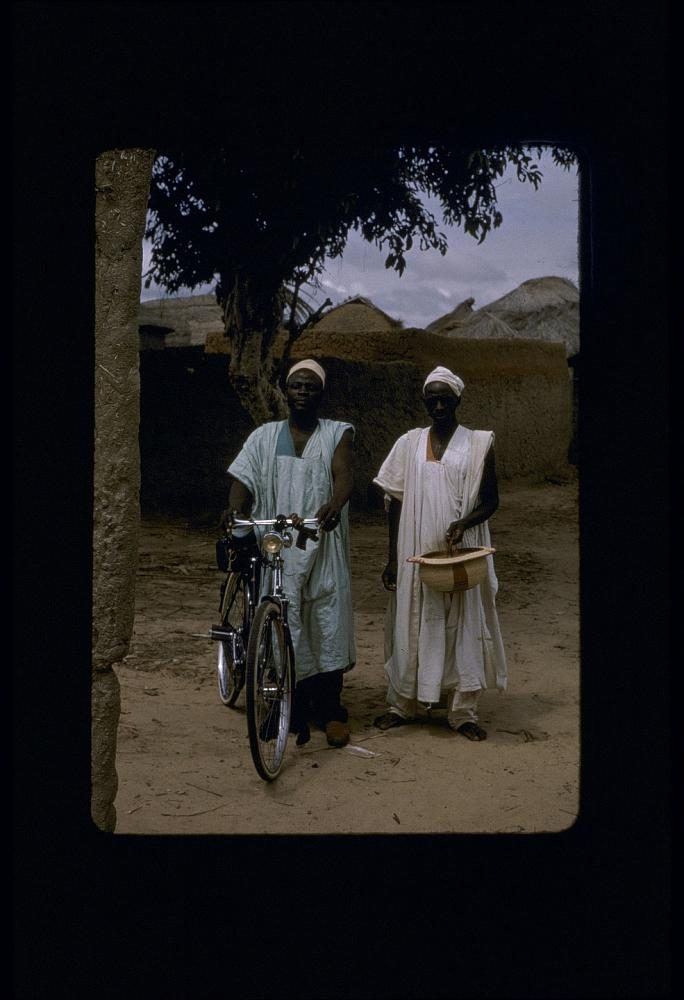
Nupe craft was guild-organised, hereditary and, with one exception, men's work. You were born into a trade, you learned it in your father's compound, and the guild you belonged to held the standards, the prices and the knowledge. Whole wards of Bida were given over to a single craft.
The full list is long, and worth reading slowly, because the length is the point: brass and aluminium smithing, ironsmithing, glass making, textile weaving, embroidery, embroidered caps, wood carving and carpentry, pottery, mat and cane weaving, terracotta tiles, and the moulded decoration on the façades of houses.
That is not a craft village. That is a manufacturing economy with a division of labour, and it is why Nadel reached for the word Byzantium.
Movement 04 · Material culture
Brass, and the men called tswachi.
Bowls, trays, ceremonial regalia. Cast by the lost-wax method, hammered cold, and traded from Kano to Benin.
The Nupe word for brass smiths is tswachi, and most of them have always been in Bida. What they make is domestic and ceremonial in roughly equal measure: bowls, trays, goblets, regalia for the emirate, and objects for religious use.
Two techniques run alongside each other. Sheet brass is worked cold; the sound you hear from our courtyard before eight in the morning is a hammer on a form. And for jewellery and finer objects, the lost-wax method: a model in wax, a clay mould built around it, the wax burned out, the void filled with molten metal, the mould broken to release a piece that exists only once.
-
01
The model
The object is built in wax, at full size, with every detail that will appear in the finished piece.
-
02
The mould
Clay is packed around the wax and left to dry, with channels left for pouring and for air to escape.
-
03
The burn
The mould is fired. The wax runs out and is lost, hence the name, leaving a cavity in the exact shape of the model.
-
04
The pour
Molten brass fills the void. The metal takes every mark the wax carried, including the maker's fingerprints.
-
05
The break
The mould is destroyed to release the casting. One mould, one object. There is no second copy.
That last step is why lost-wax pieces are worth understanding before you look at one. The process guarantees the object is unique, not as a marketing claim but as a physical consequence: the mould cannot survive its own use.
Brass survived the twentieth century better than any other Bida craft, largely by adapting. When aluminium became cheap and available, the smiths added it, and the guild absorbed a new material without abandoning the old one. That flexibility is why the Wednesday market still has brass on it.
Movement 04 · Material culture
The secret.
One guild, claiming descent from eighteen Egyptian glassmakers, held the formula for their own raw glass for nearly two centuries. It is the most extraordinary thing in Bida, and it has nearly gone.
The glassmakers of Bida are the Masagá. They are fully part of the wider Nupe community and they also hold themselves apart from it, on the basis of an origin story: their oral tradition says they descend from a band of eighteen glass artisans who came from Egypt and settled in Bida during Tsoede's reign, bringing their knowledge with them and, according to the account, bringing raw glass to start with.
The guild is hereditary, closed, patrilineal and Muslim. What it protected was a formula for making glass from scratch, not melting down imported glass but manufacturing it, and that formula stayed inside the guild for something close to two hundred years. The glass it produced is a black, shiny raw glass, and the main raw material for Bida glasswork from the middle of the nineteenth century into the twentieth.
The furnace
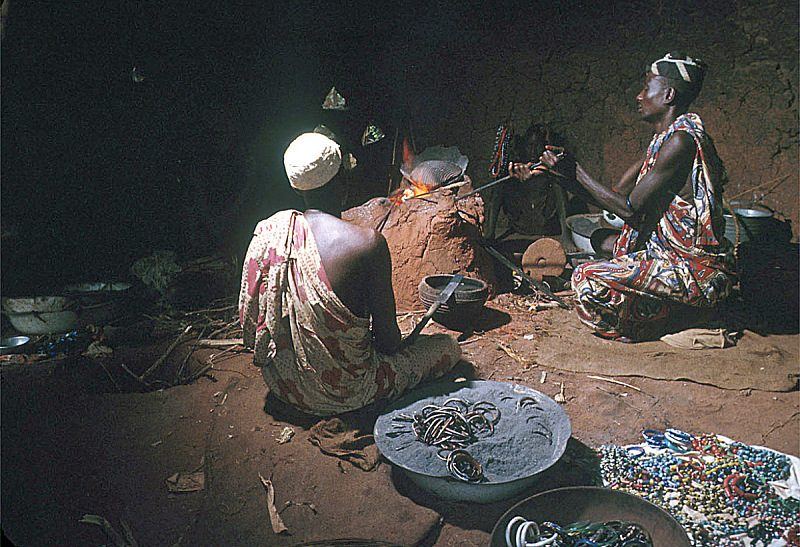
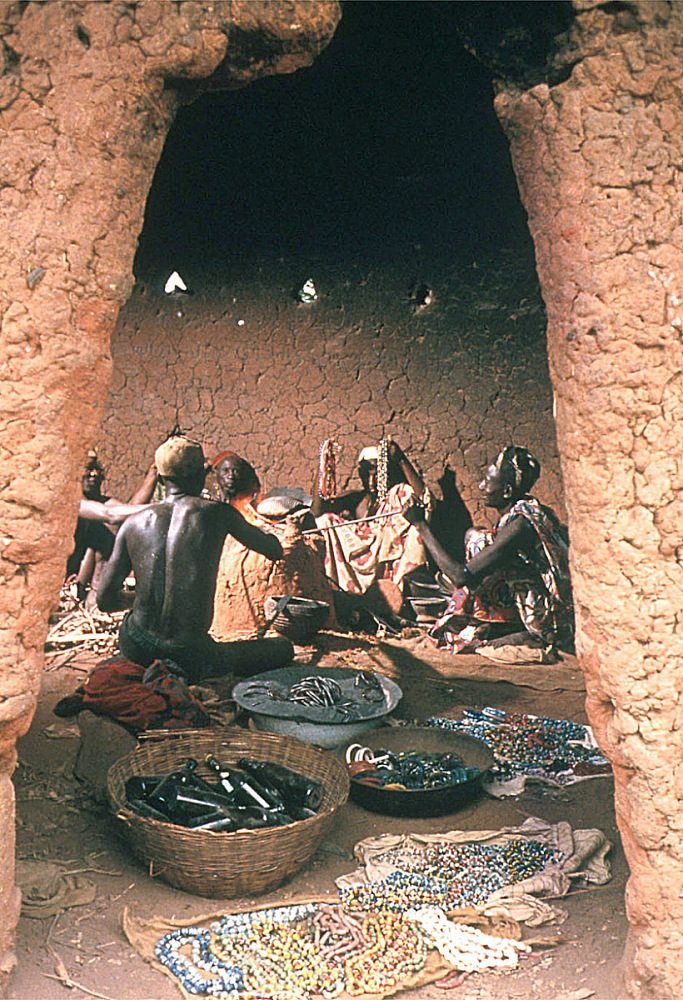
The work happens around a single structure, and the structure is unusual enough that museums describe it in detail: a domed furnace with its base dug into the ground, a hole at the top of the dome to let smoke out, and a constant feed of air from bellows worked by hand. It is fed and kept going by a team, not an individual.
Inside that team, the roles are fixed. One worker's entire job is to keep the melt viscous: not too stiff, not too runny. The others dip iron rods into the glass, lift out a gob, and rotate it quickly to shape it before it sets. Beads, and bangles.
Why the bangles matter
A seamless glass bracelet, made by hand, without blowing the glass.
The same problem the La Tène Celts solved and Europe then forgot, which is why the Masagá furnace has been studied by archaeologists working on Iron Age Europe
That is not a decorative comparison. Seamless glass bracelets were made in Iron Age Europe by a technique that was lost, and the Masagá make them now, which means the workshop in Bida is one of the few places on earth where the problem is still being solved in front of you.
What changed, and what was lost
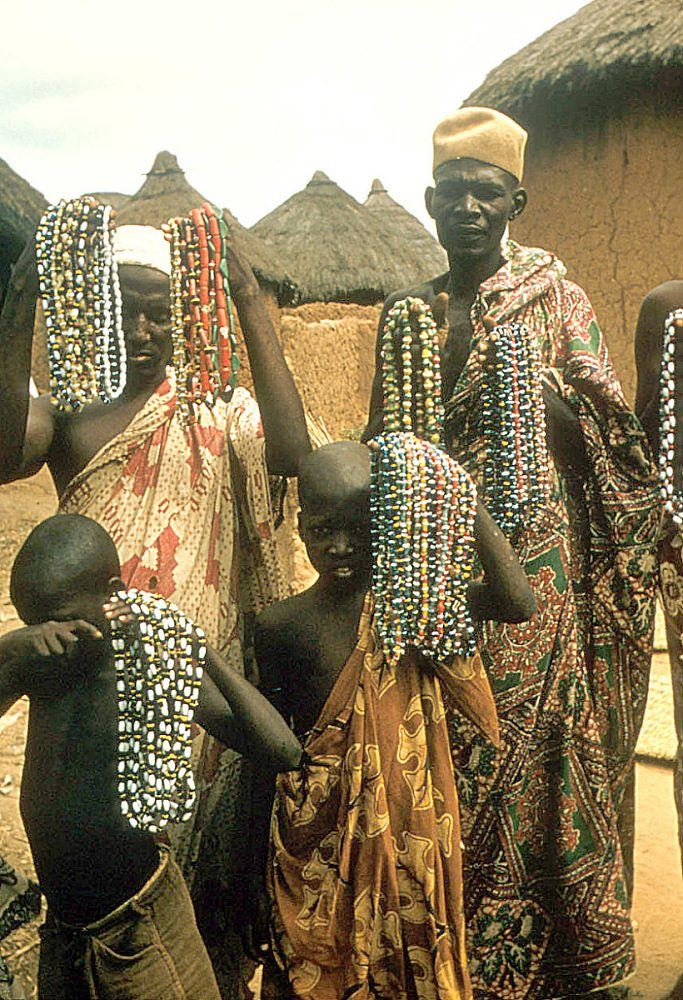
Two things happened. European glass bottles arrived in Nupeland in the late nineteenth century, and colonial trade made them plentiful. Recycled bottle glass is easier, cheaper, and comes in colours the guild could never have made, so the beadmakers began melting bottles in the small clay wood-burning furnace and forming the molten glass with iron rods, exactly as before but with a wider palette.
The other thing is the loss. Producing bikini itself required raw materials that became expensive and hard to source; the sand and soda ash were brought from as far as Lake Chad, later from Kano, and the firing takes weeks. So the production was largely phased out. A formula kept secret for two centuries was not stolen or forgotten; it was priced out.
European attention to all of this began in 1911, when the German ethnologist Leo Frobenius documented the beadmakers' technique. Examples of Bida glass are now held in museum collections abroad, including at the Corning Museum of Glass. The guild is still working. Whether it will still be making its own glass in a generation is an open question, and there are projects underway specifically to record the knowledge before it goes.
Movement 04 · Material culture
Cloth was the exception.
Every other Bida craft was a men's guild. Weaving was women's work, done in the passageways of the compound, and it is the tradition that has lost the most ground.
Read any account of Nupe craft and the same sentence appears: the traditional industries are guild-organised, hereditary, and done by men, except for cloth weaving. That exception is the most interesting thing on the list.
Nupe women wove inside their own compounds, in the passageways between rooms, on narrow looms. What they made was not everyday material. They wove marriage cloths known as duna, and elaborate red wrapper cloths, and they were doing it long before imported fabric reached the market. The most significant ceremonial cloth, ede kpasa, still holds that place.
Alongside the weaving: indigo. Dyed in sunken pits, the cloth dipped and re-dipped and layered until the blue goes almost black. It is the colour this hotel is named in, and it is not a coincidence; it is the colour of the place.
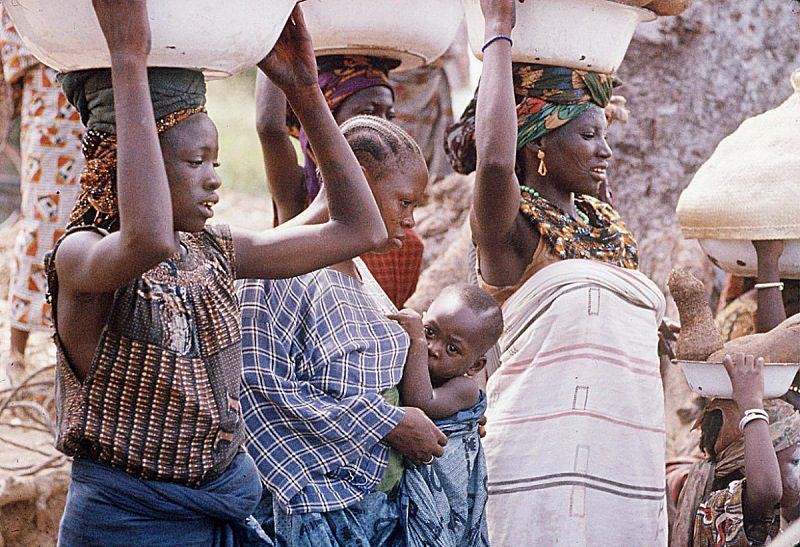
The decline is real and dates from the middle of the twentieth century. Imported fabric was cheaper and endlessly various, and it won the daily market. But the framing that matters is the one the tradition's own scholars use: printed cloth is worn alongside the indigenous textiles, not instead of them. A community that had always absorbed outside materials into its own work absorbed one more.
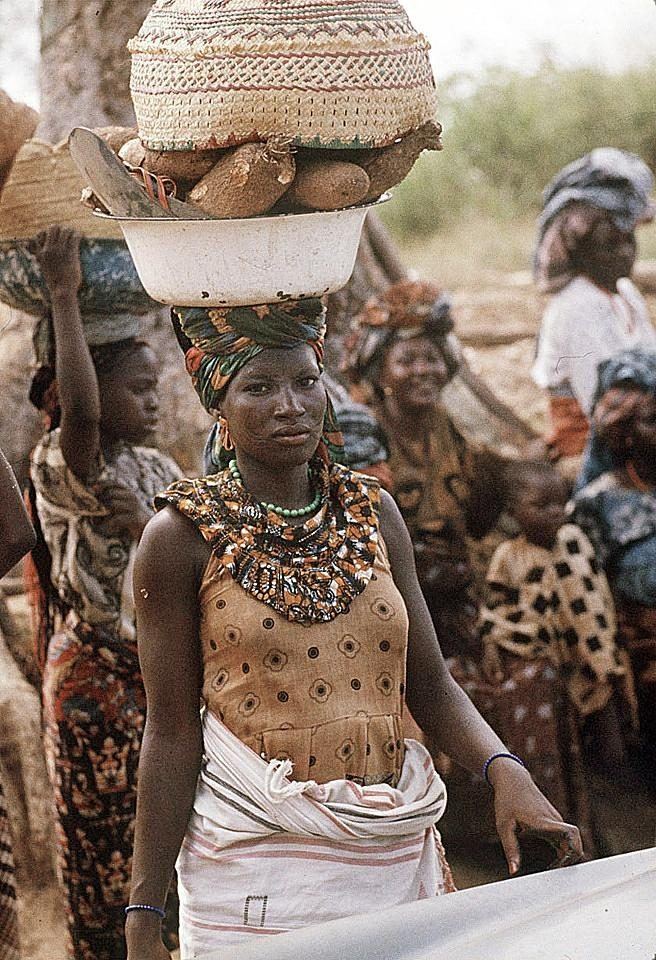
You can see the whole argument in a single photograph. Look at the water carriers below: printed cotton, a plain indigo wrapper, and a striped hand-woven cloth with a red selvedge, all on the same morning, in the same yard, on people who would not have thought of it as a contradiction.
The four trades, in the brand's own glyphs
- Brass, tswachi
- Glass, the Masagá
- Weaving, duna
- Indigo, the pits
Forty cultural glyphs were drawn for this brand, from the anvil to the mortar and pestle. They are editorial marks; they appear in galleries like this one, and never inside a button.
A note on the archival photographs. The images in these galleries are held by the Eliot Elisofon Photographic Archives at the National Museum of African Art, Smithsonian Institution. The collection requires that permission to reproduce is obtained in advance, and it remains subject to copyright. We have not recreated, redrawn or generated any of them.
Sources
- S. F. Nadel, A Black Byzantium: The Kingdom of Nupe in Nigeria (Oxford University Press, 1942). The guild economy, the Tsoede material, and the observation on glassmaking flux.
- L. Lababidi, A. B. Babalola and B. Gratuze, "The Making of Bikini Glass in Bida, Nigeria: Ethnography, Chemical Composition, and Archaeology," African Archaeological Review 40 (2023), 397–424. The bikini formula and the furnace re-enactment.
- Leo Frobenius, first European documentation of the Bida beadmaking technique, 1911.
- Corning Museum of Glass. Descriptions of the Masagá furnace, the guild's division of labour, and the seamless-bangle technique.
- Endangered Material Knowledge Programme. Current recording of Masagá glass and bead making in Bida.
- Eliot Elisofon Field Collection, EEPA 1973-001, Eliot Elisofon Photographic Archives, National Museum of African Art, Smithsonian Institution. The photographs in these galleries.
- Michael Mason, "The Tsoede Myth and the Nupe Kinglists: More Political Propaganda?", History in Africa. The historiographical argument.
- House 7 Hotels & Resorts. Contemporary photography of the brass workshops.
Ask at the desk and we will point you to the workshop, not the gift shop.
Thursday mornings are usually free. Send us a message on WhatsApp and a person at the front desk replies.
Reserve a room